Practical ideas for a service business, with illustrative prices and reply templates. Tool references checked 15 October 2026; no affiliate links.
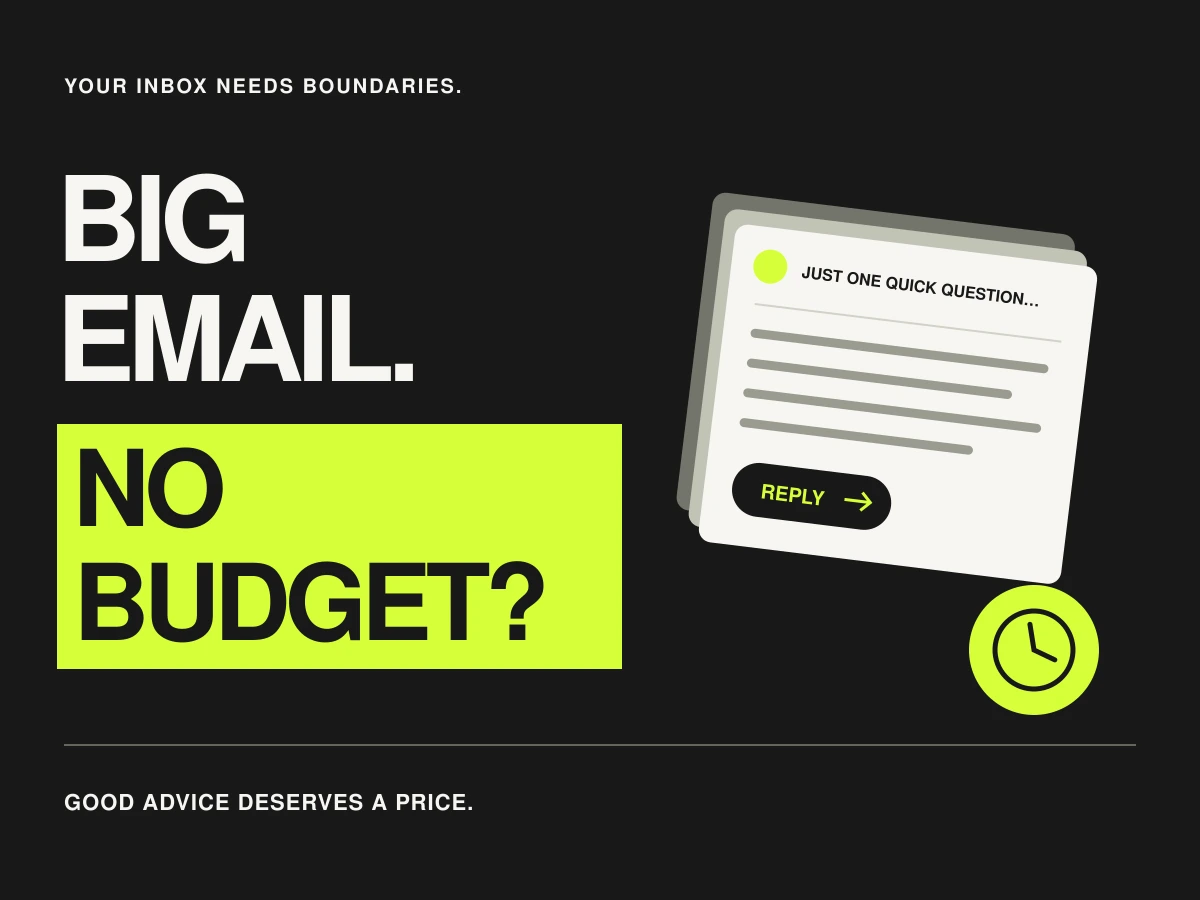
You know the email. It starts with how they found you, takes a scenic route through their entire career and finishes with a business idea that sounds genuinely exciting. They are finding their people. Planning the launch. Getting their team together. They haven’t bought the domain yet, but they would love to pick your brain. By the time you have written a thoughtful reply, you have already started working for them.
The big idea. The long email. The disappearing act.
If you have been doing this for a while, you may recognise the pattern. A handful of enquiries arrive. Some have a clear job, a budget and a date. Others have possibility. Lots of possibility. You reply, they reply, you make a few suggestions, they ask what you think of those suggestions, and suddenly there is a free discovery call in the diary.
Then nothing. No project. No payment. Possibly a return visit six months later with a different idea and another very long email.
‘Time-waster’ is the frustrated shorthand. But someone who is not ready to buy is not necessarily a bad prospect, and a long email or an unlaunched business does not prove they will never pay. The useful distinction is whether they are ready to commit to a clear next step. You can find that out without donating the afternoon.
They might become a service client. They might buy a small resource and do the work themselves. They might leave with a polite answer and no purchase at all. Your process should make room for all three outcomes without requiring hours of unpaid advice.
Find out where they are before telling them what to do
You do not need to answer every point in the opening email. First establish what they are actually asking you to provide. Someone saying ‘I need a copywriter for these five pages next month’ is at a different stage from someone asking whether their idea should become a website, a course or an app.
- What exists already? A live business, an audience, a first product or simply an idea? A link is helpful where there is one.
- What would you like my help with? Ask for the immediate job or decision, rather than the whole five-year vision.
- When do you want to begin? ‘This month’ and ‘when everything is ready’ need different responses.
- What budget have you set aside? Share your own starting fee so they can answer against something concrete.
- Are you looking to hire someone, or learn how to do it yourself? Both are valid. They belong in different offers.
Keep this short enough to answer in one reply. An elaborate application form can create more friction than clarity. You are checking readiness and fit, not asking a new founder to prove they deserve help.
A useful signal is what happens next: do they answer the practical questions, choose an option and follow the booking process? Repeatedly avoiding those questions while requesting more recommendations tells you more than whether they have bought a domain.
Yes, you can charge for the conversation
You can choose to offer paid consultations for incoming enquiries. The important part is making the offer and price clear before they book. If they are paying, the session needs to deliver something useful even if they never hire you afterwards.
A sensible starting policy: if you approached them, offer a complimentary introduction. If they approached you for your thinking, offer a paid session. You have chosen the first conversation as part of your own business development. The second is someone requesting access to your expertise.
That does not mean charging someone to ask your availability, understand a package or find out whether you work in their sector. Answer ordinary buying questions briefly. For a promising incoming project, you can still choose a short free fit call. The boundary is crossed when the conversation becomes an audit, a diagnosis or a tailored plan.
Consider calling the paid option a ‘clarity session’, ‘planning consultation’ or ‘expert review’. ‘Discovery call’ can sound like a sales conversation. Give the buyer a specific outcome: one decision worked through, a shortlist of priorities or feedback on a defined piece of work.
| The conversation | Illustrative price | Keep it within… |
|---|---|---|
| An introduction you initiated | Complimentary | 15 minutes to discuss fit, the brief and possible next steps. No bespoke audit. |
| A focused incoming advice request | £75 | 30 minutes on one topic, with up to 10 minutes’ preparation and a short follow-up taking up to 10 minutes. |
| A more involved planning session | £150 | 60 minutes, a defined pre-read and a concise action summary. Budget no more than 90 minutes of your time in total. |
| An early-stage person who wants to DIY | £19 example resource | A finished, self-guided pack for one specific job. No personalised review or open-ended email support. |
These are example offers to adapt, not recommended rates for every profession. Price the preparation, delivery and follow-up together. A £75 session taking 50 minutes in total is £90 per hour of gross revenue before fees, overheads and tax—not the £150 an hour suggested by counting only the half-hour call.
State the duration, topic, inclusions, total payable price and cancellation or rescheduling terms before payment. Collect the fee at booking. If they send a twenty-page document for a session that includes a short pre-read, agree the extra scope first.
You can credit the consultation fee against a later project, but make it a deliberate offer. For example: a £75 credit against a £750 project leaves £675 to pay. Set any eligibility and time limit clearly in advance. Do not quietly promise a credit on every tiny follow-on job, or make the paid session an hour-long pitch for the bigger package.
Keep a smaller offer in your back pocket
Some people do not need your full service yet. They need a good starting point, a little structure and permission to stop researching. This is where a focused DIY product can be useful.
You do not have to turn your service website into a download shop. Keep the main site focused on your core work, and offer the resource directly when it fits an enquiry. A clear description and an unlisted purchase link can be enough. ‘Private’ here means offered selectively; an ordinary unlisted link can still be forwarded.
The resource should solve a smaller problem than your service. It should be useful on its own, with enough detail for the buyer to act. A generic PDF whose final page says ‘book me to find out more’ is a sales brochure with a price tag.
| Your service | A useful private DIY offer | What makes it worth buying |
|---|---|---|
| Email marketing setup | A first welcome-email planning pack for an independent product brand | An annotated example, a fill-in structure, a setup checklist and a way to review their draft. |
| Website copywriting | A five-page website briefing workbook for a solo service business | Specific prompts, worked examples and a checklist of the facts they need before writing. |
| Social media management | A first-month content-planning kit for a particular trade | Realistic post prompts, an example schedule and a simple method for choosing what to publish. |
Build from questions you already answer and expertise you can demonstrate. Use your own examples and material you have permission to share. Your explanation of why something works, common mistakes and the decisions behind a good example can be more helpful than another pile of blank templates. Our guide to making digital guides worth paying for explores that in more detail.
Keep the price accessible enough to make sense for the smaller outcome, while checking the time and costs it creates. The £19 example above is a starting hypothesis, not a guaranteed sweet spot. A low-priced product with an hour of personalised support attached can recreate the original problem.
Be explicit about what is included: file format, contents, who it suits and whether any feedback comes with it. Deliver it properly, help with access problems and keep the scope clear. A question about a broken download is customer service; a request to review their entire business plan is a separate service.
A good resource may help someone see your value and later book you. It may also help them stay DIY and keep startup costs manageable. Both are legitimate outcomes. Sell it because it meets their present need, rather than assuming every download will lead to a retainer.
Seven replies that keep the conversation useful—and contained
Use these as starting points, not messages to paste blindly. Replace the bracketed details with your actual offer, total price and working link. Match the warmth of the enquiry without matching its word count. One acknowledgement, one boundary and one clear next step is often enough.
1. The long opening email with no clear brief
Hi [Name], thank you for sharing the background—it’s helpful to understand what you’re building. To recommend the right next step, could you tell me the main thing you’d like help with, your intended start date and the budget you’ve set aside? My [service] starts at [price]. If you’re still deciding on the direction, I also offer a [duration] planning session for [price], focused on [outcome].
This acknowledges the effort without responding to twelve separate ideas. You have supplied the information needed to make a buying decision and asked for the information you need to assess fit.
2. ‘Could we have a quick call so I can pick your brain?’
Hi [Name], I can help you work through [specific question]. My [session name] is [price] for [duration] and includes [precise inclusions], so you’ll leave with [realistic outcome]. You can see the details and book here: [booking link]. If you have a question about what the session covers, I’m happy to clarify before you book.
You do not need a paragraph defending your fee. Describe the paid option with the same calm confidence you would use for any other service.
3. They are too early for your full service
Hi [Name], from what you’ve shared, I think the most useful next step is to get [specific foundation] in place before investing in [full service]. I have a self-guided [resource name] for [price] that covers [two or three concrete inclusions]. It’s designed for people doing this stage themselves and doesn’t include personalised feedback. If that sounds useful, the details and purchase link are here: [resource link].
Only send this when the resource genuinely fits. If you do not have a suitable offer, a polite explanation is better than selling them something unrelated. There is no requirement to extract a purchase from every enquiry.
4. The second email asks you to map out the whole strategy
Hi [Name], those questions are the areas I would work through with you in [paid service]. I’d need to review [relevant context] before making recommendations, so I won’t try to give you a tailored plan in an email. The next step is [session or project], which includes [scope] for [price]. You can find the details here: [link].
You can explain your method, show relevant work and describe what they will receive. You do not need to supply their specific recommendations, finished copy or implementation plan to prove you can do the job.
5. You approached a business you would love to work with
Hi [Name], as I reached out to you, I’d be happy to arrange a complimentary 15-minute introduction. We can talk through [relevant need], what working together could involve and whether there’s a fit. If you’d like a detailed review or recommendations afterwards, I can outline a paid next step. Here’s the introduction booking link: [link].
Keep the promise you made. A complimentary introduction should remain complimentary, and a paid next step should be optional and agreed before any work begins.
6. ‘Could you just send a few ideas before we decide?’
Hi [Name], I can share relevant examples of my work and explain how I’d approach the project. Bespoke concepts and recommendations are part of the paid work, so I don’t prepare those at proposal stage. The proposal will set out the deliverables, process, timings and fee so you can decide whether to go ahead.
A proposal can be specific about the work you will deliver without doing that work for free. If a proper quote genuinely needs investigation, offer a separately scoped paid discovery stage with an agreed output.
7. They keep circling, or disappear after the options
Hi [Name], I’m following up once on the options I sent over. If you’d like to go ahead, the next step is [booking or acceptance step]. If the timing isn’t right, that’s absolutely fine—I’ll close the enquiry for now. You’re welcome to get back in touch when you’re ready, and I can confirm availability and pricing then.
For repeated requests for free advice, leave out the follow-up invitation to discuss more and restate the paid route once. You can end the exchange politely. Silence does not require a new discount, a free audit or another three emails.
And when the free call starts becoming a workshop…
Set the expectation at the beginning: ‘We have fifteen minutes today to understand the brief and whether I can help. If you need recommendations, we can arrange a separate planning session.’ Have a simple agenda and finish at the agreed time.
That’s exactly the sort of question we’d work through in the planning session. Today I can explain what that includes and whether it’s the right next step for you. Shall I talk you through that?
At the end, name the next step and stop. You can send a short recap of the service discussed without attaching the strategy you deliberately kept outside the call. If they want to extend the conversation, agree another booking rather than letting the meeting drift.
Make the boundary a process you can repeat
- Keep your starting prices easy to find. A private DIY product can sit behind the scenes while your core service pricing helps buyers assess fit.
- Save a small set of replies. Personalise the relevant sentence, choose the appropriate next step and resist answering questions outside that scope.
- Use separate booking options. One short complimentary introduction for people you invite; one clearly described paid consultation for advice.
- Protect delivery time. Limit how many consultations you offer and leave room for the preparation and follow-up you promised.
- Review the result. Track time spent on enquiries, paid sessions, resource sales and subsequent projects. Check what remains after delivery time and costs.
For a simple setup, Calendly’s Stripe integration supports collecting payment during booking on paid Calendly plans. Stripe Payment Links can provide a checkout link you share directly. Check the current plan requirements and fees before choosing tools, and arrange how the buyer will receive the resource; taking payment is only one part of fulfilling the order.
You do not need a complicated funnel to start. An enquiry form or a short qualifying email, two clear offers and a few saved replies may be enough. If you are already at capacity, our article on earning more without adding more hours is a useful companion.
You can be generous without becoming their unpaid business partner
A dreamer may become a doer. An early-stage founder may eventually become a brilliant client. You can welcome that possibility and still decide that the next hour of your expertise has a price.
The win is not always a new booking. Sometimes it is a £19 sale that helps someone move forward. Sometimes it is a paid conversation that answers the question properly. Sometimes it is twenty minutes back in your day because you stopped writing a proposal for a person who was only asking what was possible.
Be warm. Be clear. Give them a useful next step. Then let them decide whether to take it.